Music · TRF-001
The Wittgenstein
Dope Surfers
A musical collective designed to outlive its founders.
The Wittgenstein Dope Surfers is an experimental art-rock collective conceived by Belgian multidisciplinary artist Reinout Zeeger (Xavier Van Eeckhoutte). Its music moves between neo-psychedelia, repetition, noise, melody and philosophical narrative.
TWDS is not intended to exist for a single album cycle. It was founded as an experiment in time: a musical identity capable of continuing for fifty, one hundred or even two hundred years. Musicians may enter and leave, but the collective—and the questions it carries—remain.
Within The Reincarnation Factory, TWDS gives sound to the same territory explored through photography, writing and Transformism: the unstable border between presence and absence, the visible and the hidden, destruction and renewal.
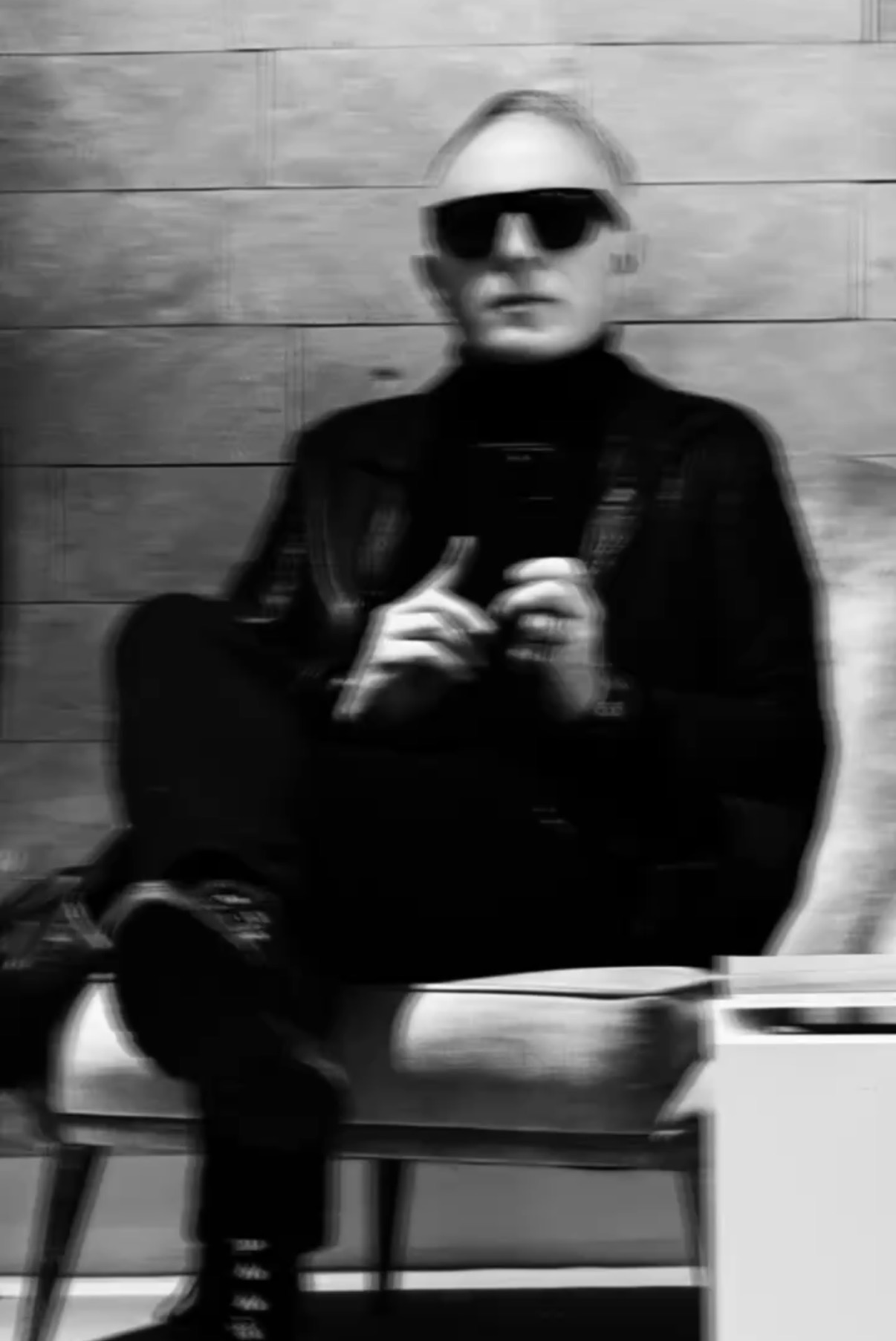
The meaning of the name
Where language
becomes music
The name The Wittgenstein Dope Surfers begins with a question: how can we reveal what lies deepest within us when language itself is unstable?
It takes its point of departure from Ludwig Wittgenstein’s exploration of the limits of language. Words do not carry precisely the same meaning for everyone. We hear them through different histories, experiences and inner worlds; what one person intends is not necessarily what another understands. At the point where language can no longer fully contain or communicate an experience, TWDS turns to music. Sound, rhythm, repetition and dissonance become another form of disclosure—a way of making inner realities perceptible without first having to translate them into explanation.
Surfers refers to the attempt to follow the movement of the waves while remaining upright: the waves of a single life, but also those of our countless incarnations. In that sense, we surf through the universe and through time itself—through a block universe in which past, present and future are not separate territories, but coexist as one.
This movement is embedded in the music: waves of tension and release, noise and melody, impact and return. The Wittgenstein Dope Surfers are therefore not simply an experimental rock band. They are an existential-philosophical collective seeking, through music, what words alone cannot reveal.
Why the masks
Beyond
the ego
The masks do not conceal identity; they loosen its authority.
The Wittgenstein Dope Surfers regard the ego as a construct: a practical interface through which we navigate the world, useful but provisional, and never the totality of who we are. By covering the face, the musicians temporarily step outside biography, status and social role. The individual recedes; archetype, sound and collective presence emerge.
The mask does not erase the self. It creates room for what may exist beyond it.
The image
The Fight
of Life
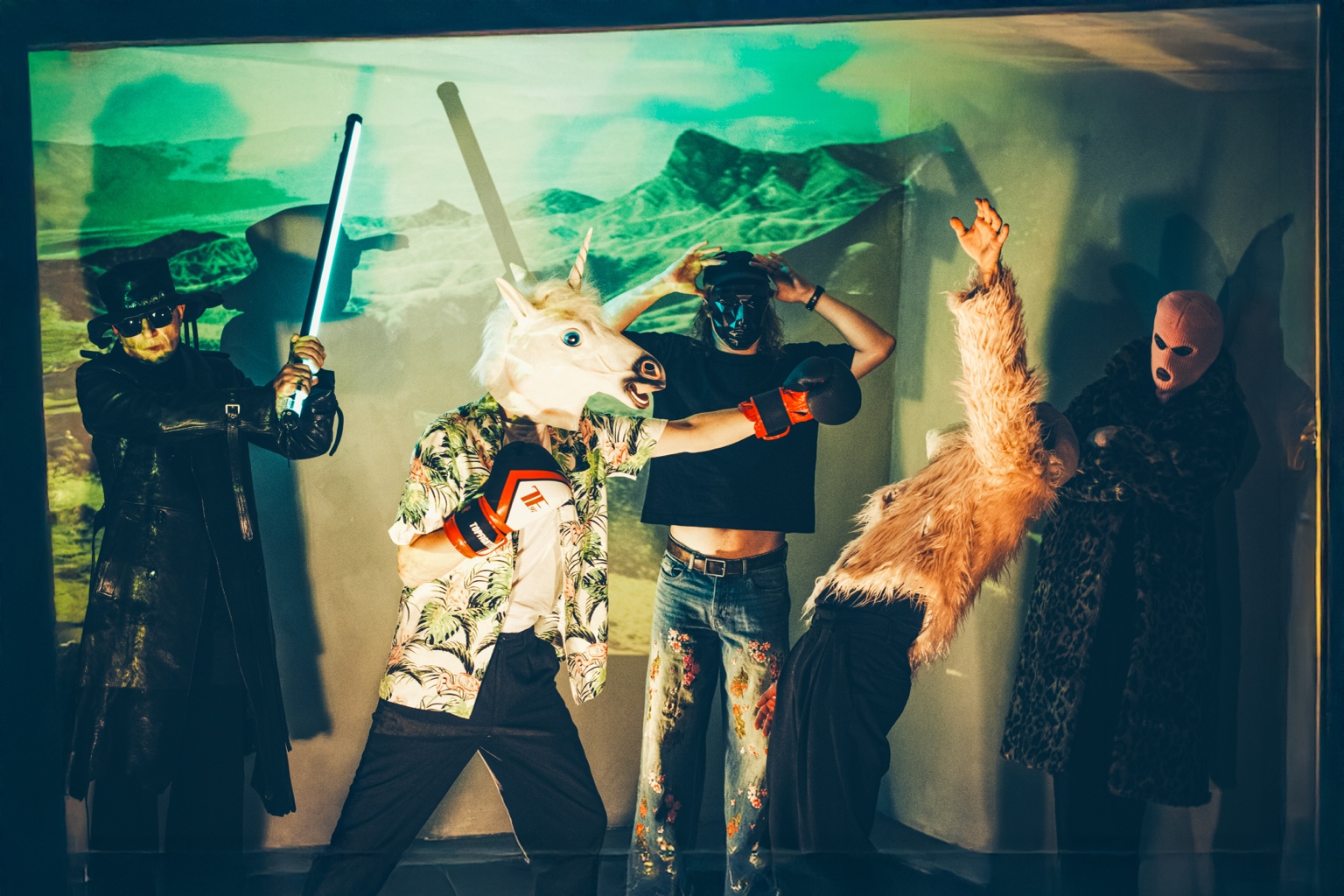
In Carmen De Vos’s portrait, The Wittgenstein Dope Surfers appear as five masked figures caught between ritual, theatre and combat. Their identities become archetypes: The Wizard, Unicorn, Angel, Lady and Maniac.
At the centre stands the boxer—a symbol of life as a continuous struggle. Knocked down by forces beyond our control, we rise and enter the fight again. Not because suffering is necessary, and not because every wound automatically makes us stronger, but because pain does not have to be the final outcome.
The boxer becomes a perpetuum mobile of transformation. Every impact is absorbed, redirected and converted into movement. What was meant to break us becomes material for positive action.
The fight is not against life. It is the struggle to remain alive within it—and to begin again.

Album artwork by Pieter Willems.
Debut album · TRF-001
Marfa Lights
Marfa Lights is the first album by The Wittgenstein Dope Surfers and the inaugural release of The Reincarnation Factory: TRF-001.
The record forms part of the same artistic universe as Reinout Zeeger’s photographic exhibition MARFA LIGHTS — 25 Unexpected Visitors. Its cover image shows Aero(nwen)’s empty boots beneath a streetlight in Marfa, Texas—a photograph in which absence becomes a form of presence.
The album is dedicated to the memory of Aero(nwen).
Released as a limited first pressing of 300 copies on 180-gram vinyl, Marfa Lights is conceived not simply as a recording, but as an autonomous art object in which music, photography and text converge.
Firelane is currently available as an advance stream. The complete digital release will follow the accompanying film.
The record
Tracklist
Side A
- Hiss (Overture)
- Firelane
- Ha Na Ja Ha
- Nowhere
Side B
- Ja / Nee
- Saturday Eternal
- The Watcher
The collective
Credits
- Concept and lyrics
- Xavier Van Eeckhoutte
- Music performed by
- Hannes Cuyvers
Sybe Versluys
Jesse Vandecaetsbeek
Iskander Moens - Lyrics musically adapted by
- Iskander Moens
- Produced by
- Pascal Deweze
- Recorded by
- Joel Workman and Pascal Deweze
- With special guest
- Peter Vermeersch
- Choir
- Dionysos Now!
- Gatefold photography
- Carmen De Vos
- Released by
- The Reincarnation Factory
TRF-001 - Thanks
- Thanks to Leen Defoer for making this possible.